

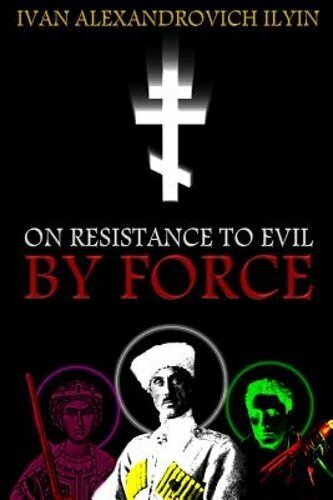
Ilyin first describes our moral obligation to first attempt through conversation to change someone's evil will. After that, we can then morally resist their evil deeds. Our requirement to live together in harmony requires to try and stop evil deeds while they are still just thoughts, to permanently change someone's will.
He points out that we are the worst judges of ourselves. We all keep and inner and outer self; one reserved for ourselves and one that is public-facing. We all self-delude ourselves into believing that we are always the good guy and that we have no faults. We get mad when we are "unfairly blamed", when actually being called out for our bad behavior.
Ilyin describes nonverbal communication well. Every act or attitude we take is physically manifested within us and becomes part of our outward appearance, whether for good or bad, if peolpe just take time to notice. He calls it "unconscious integrity of communication and transmission".
According to Ilyin, you cannot be "evil inside" or "good inside", and not have it affecrt teh outside world. If you have evil inside, you spread evil around you. If you are good inside, you spread good to all those you touch. "A good man is a living hearth of good & strength in good, while an evil man is a living hearth of evil, strength in evil and weakness in good."
We have a duty to resist evil interally within us.
Ilyin says that we are OBLIGATED to resist evil everywhere for the good of all. He says we are obliged to fight evil at every turn and that we have no right at all to allow evil to go unchecked. We MUST act against and not let it mutliply. He claims this is a spiritual call and a public duty.
He says there is no right to commit evil. Those who are naive enough to believe that others have a freedom to commit evil will eventually become slaves to it.
After describing this, he points out again that we all have a public duty for the good of all to actively resist evil anywhere. We obligated to resist evildoers and villains as well as to resist proactively and effectively.
"Anyone who sends evil must always be cognizant of this and accept that others will be permitted to put a stop to his wicked acts and force him to qualitatively review the evil he sends"
That quote was the basis for law and safety in the old west - before I attack someone, I have to decide if I'm willing to get shot for it. We need to RETVRN.
Ilyin says that as a society, we all have a desire to see good grow. Evil people threaten that and threaten our peace, so we must unite against villains in our midst. Those villains must be met by united resistance and opposition. Ilyin points out that the resistance to evil is done by few on beahlf of all and benefits a community as a whole.
In the book, Ilyin points out that for any central authority, whether state or church, to exist, it must be supported by the people for the good of the whole, with submitting to it for the good of all. He believed that the reason that Russia turned communist was because the people desired to submit to the state for the good of themsleves (taking from the rich and giving it to the individual). The US Constitution as originally written met Ilyin's requirements. Notably, the church's "Military Orders" or knights, also did. When governments failed to protect citizens, the church did, and the citizens willingly submitted to the local order.
He points out something here that illustrates our current issues. He said that as soon as a government begins to appease the villains or the people harbor them, society falls. That's exactly where we are today.
Let me know your thoughts below.