Tactical Wisdom
Politics • News • Preparedness
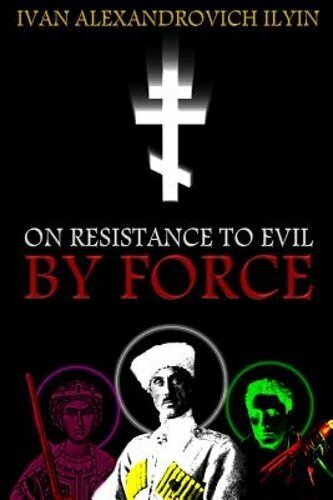
On Resistance to Evil by Force Study
Chapter 9: On the Morality of Flight
March 16, 2026
post photo preview

First, let me apologize fo the delay.  The Iran War and a prolonged power outage kept me from getting these out.  Mea Culpa and all that.

The topic of this chapter is the relative morality of avoiding the issue of resisting evil.  The central point is that Tolstoy and the "Jesus is My Boyfriend" or "Love is all" Christian Church posit that only your own morality and actions matter.  You cannot influence others by any way other than reason and that you cannot and should not condemn or judge the actions of others as evil or wrong, as they do not concern you.  While that sounds right on the surface, "Judge not lest you be judged", on a big enough scale, its allows evil to win.

Ilyin states that the idea of non-resistance to evil under any circumstances is juvenile at best.  It's not rooted in reality because evil does indeed exist and evil acts are perpetuated against good people.  The idea that evil acts don't really affect anyone other than the person doing them is intellectually dishonest.  There is always a victim.

The general puprose of humanity is to always improve ourselves and to always expand our abilities, according to Ilyin.  I agree with this, as I think training is important.  

Ilyin warns that people who write or teach others in response to this quest for self-improvement inherent in us all have a responsibiltiy to actually study and learn about things, rather than just express their own opinions, infected by their own biases.  He points out that these opinions are often wrong.  People who think too highly of themselves tend to pontificate their own, incorrect, opinions as fact.

A great point he makes here is that in order to properly define evil (or love, really), one must see & experience it personally, rather than just think about it in the abstract.  I agree, as anyone who has ever seen the evil men do upon other men will tell you that evil is real and needs to be opposed by strong men and women of virtue.  Otherwise, any discussion of good and evil is just an academic fallacy, presented as fact (the modern church). 

I want to expand on this idea for a second, with my own concurring ideas.  The modern church will tell you that you can never condemn others, especially another entire religion.  They will also tell you that the responsibility for protection has passed to the State, not to you, as a Christian.  However, the medeival church experienced firsthand the evil that Islam and her soldiers did upon Christians.  Their opinion was very different, and from that, when governments failed to act, the first Military Orders of Christ (THE KNIGHTS) were born.  A major historcal fallacy is that Kings and Queens knighted people.  In the modern world, I guess so, but originally, the CHURCH decided who earned the title of Knight.  While some Kings led Knights, the Knights represented the CHURCH and GOD, not the Nation-State.  They fought with the King, not for him, and this led to some spectacular disagreements.  This is coming full circle today, with Islam openly attacking both Christians and Jews once again (still).

Note:  God believes in ONE religion, and it is not Islam.

Ilyin points out that Tolstoy, and in our case the modern church, excuse evil acts as errors, mistakes, weaknesses, passions, and the like, rather than as a manifestation of evil.  They say that a good person must ignore these acts in others and be concerned only with themselves.  They constantly warn against judging or condemning any sin, rather insisting on "loving the sinner".  This is NOT Biblical.  This avoids the issue (hence "FLIGHT" in the Chapter title).  The effect of this leads to a great quote in the chapter: "Virtue enjoys its love and vice freely unleashes its evil will into the world."  Based.

Tolstoy insists that his position is reason and that any disagreement with it is "false".  That sure sounds like the modern left arguing about literally anything, doesn't it?  People believe things that aren't true and refuse to even give life to any argument that fails to confirm their bias.  It doesn't make them right, it just makes them FEEL that they are right.  You cannot reason with that.

Ilyin says that thinking only of ourselves and being concerned only with our own actions & "doing good", rather than stopping the march of evil is self-centered and gives no consideration to the greater good.  This reminds me of the meme with the guys on their knees in front of the executioner saying "at least we didn't give them a reason, right?"  This is a classic formulation of the "Main Character Theory", where you are the main character in a movie and everyone else is just an extra.  It's a logical fallacy.

The problem, according to Ilyin, is that when faced with a national evil (a communist revolution in his case - and ours) this type of person is only concerned with the image of how they responded to the situation as virtuous or not, hence "non-resistance" and the meme, yet again.  Rather than doing anything effective to stop the wider evil, they get to point out that they are better than their oppressors because they didn't resort to "violence" - despite violence being exactly what was needed and expected (even by God).

Ilyin illustrates this point with the example of being a witness to a riotous mob raping a child, while you have a gun in your hand.  Tolstoy, and the modern church, would tell you that violence is evil and not justified.  Ilyin asks, what will God say or expect you to do.  The answer is in Proverbs 24:11 (Rescue those being led away to death; hold back those staggering toward slaughter) and James 4:17 (If anyone, then, knows the good they ought to do and doesn’t do it, it is sin for them).

I know what I would do, and I hope you would too.

Leave your thoughts below.

 

community logo
Join the Tactical Wisdom Community
To read more articles like this, sign up and join my community today
4
What else you may like…
Videos
Posts
Articles
BattlBox Mission 134 Unboxing

Here's my unboxing of BattlBox Mission 134: Every Day Carry. I highly recommned BattlBox.

Link to BattlBox: https://classic.avantlink.com/click.php?tool_type=ml&merchant_link_id=18d5f0dc-a5d5-4617-8d89-3672fa873181&website_id=b54d42a2-3e73-4f03-ac0d-a3e7b99eed53

00:14:14
Hoplite M10 Review

My video review of the Hoplite M10 Reusable Flashbang. It's a great tool available at: https://www.hoplitegear.com/product-page/m10-havoc

00:06:46
Timeline Cleanse

Time for a timeline Cleanse before WW3 kicks off.

00:00:10
INTEL BRIEF - LIVONIA MICHIGAN

Livonia Police responded to a call about an explosion at a house. When they arrived, police almost immediately shot someone, and no other information has been released.

The Michigan State Police are investigating.

INTEL BRIEF - IRAN

Iran struck a merchant vessel in the Strait of Hormuz. This lead to US Strikes against many Iranian sites. Iran has now struck a US base in Bahrain.

What a fantastic peace agreement.

INTEL BRIEF - IRAQ

IRAQI Security forces appear to be moving into the Green Zone. There are reports of potential mass arrests of politicians. Potentially a coup underway.

post photo preview
On Resistance to Evil by Force Study
Chapter 14: On the Subject of Love

Link to buy book: On Resistance to Evil by Force

Another great chapter, but a little shorter and a bit easier to read, mostly because I already understood this concept and knew all the Scripture he referenced.

Resisting evil is ONLY meaningful if it is done on behalf of good.  In other words, only the virtuous can recognize the evil and resist it from a stance of wanting to do good.  When evil happens to oppose some other evil, it is usually in service of it's own evil ideas, rather than a desire to do good.  At best, it is a collision of evil intentions between two others.  This means that us, as the virtuous, have to fight evil on two fronts, rather than just one.  This gives lie to the idea that "the enemy of my enemy is my friend"; no, he is still your enemy and you'll have to fight him too, as soon as your paths diverge from the current same direction.  As Ilyin quoted in the book, if one snake eats the other snake, there is still a snake to deal with.

Ilyin points out that resisting evil is a net good and thus stems from spritual love.  

Love without a spiritual component is risky.  That leads to temptation and the potential to do evil under the guise of advancing love.  It becomes blind and self-defeating.  The spiritual component is what compels us to be willing to die for something other than ourselves.

Ilyin points out the truth in Matthew 22:38 (Jesus replied, "Love the Lord your God with all your heart, with all your soul, and with all your mind - this the First and Greatest Commandment", you heathens).  We must love God first in order to love our neighbors and see them in a new light.  Only then can we truly "Love thy neighbor."  Loving God is required and is inseparable from loving your neighbor.  This means that you see the Holy Spirit in others, just as it is in you.  

The movie The Road comes to mind.  In it, the father keeps telling the boy that they are "carrying the fire".  When the father dies and the boy meets a new family, he first asks them if they are "carrying the fire".  I think this is the same idea.

According to Ilyin, you must be a Son (or Daughter) of God to see anyone else as a Son of God.  This loves gives you a feeling of connection to something bigger than yourself.  These include: God, Church, homeland, your leaders, the other people.  This connects you to a cause that you would be willing to die for.

Ilyin writes that those who lack spiritual love usually put usefulness and equality above divinity (sound familiar?).  They say that everyone is equal and the no one is right or wrong.  This is where "living their truth" comes from.  They see events as destined to happen or inevitable.  They believe that everyone's happiness is more important than anything else.

On the other hand, those with spiritual love generally put divinity and goodness above all else, especially over usefulness or happiness.  Spiritual love knows that all are not equal.  This is where Ilyin drops the BANGER quote of the day: There are those "who are better off being killed than allowed to do evil."  WOW.  This is truly loving thy neighbor.  It's saying I love you too much to let you destroy your soul with an evil act, so I will stop you.  In this section, we see Ilyin quote the three eyewitness accounts of Jesus laying it down with the millstone quote (Matthew 18:6, Mark 9:42, and Luke 17:1-2).  One with spiritual love also knows the danger of letting "happiness" be the standard, because most people are perfectly happy with sin.

Another great Ilyin quote is in the chapter's closing:

"Noble death is always better than shameful life."

SIde note, in this chapter Ilyin leaves a footnote that references Heraclitus, fragment 49:

"To me, one man is worth 10,000 if he is first rate."

This means that a man with wisdom and courage is better than 10,000 without.  Strive to be the one man.  Be worthy of each other.

Let me know your thoughts below.

Read full Article
post photo preview
On Resistance to Evil by Force
Chapter 13: Overall Framework

Sorry for the delays this month - Allen's passing has really taken a lot more time and energy than I anticipated.  Thank you for sticking with me.

Ilyin opens the chapter by pointing out that only the truly good and truly faithful get to have a say in this discussion.  The spiritually lukewarm "come as you are" Christians or the "Living My Truth" folks are not morally strong enough to have a say.  They always equivocate or rationalize rather than take a stand.

An interesting point that Ilyin makes in this chapter is that no one ever asks if the villain is justified or morally right in his actions, only the righteous defender or person who intervenes.  They know that the villain isn't but did it anyway.  It's far easier to make the virtuous person feel guilty than the villain.  We saw this in our current world with both the Rittenhouse and Penny cases.  No one disucssed the attackers, just the defenders.  Saint Floyd is yet another example of this.

According to the text, our purpose in intervention should flow from a will to do good and to turn others to good.  We must aim to strengthen & implement good in the soul.

The weak and fearful always equalize good and evil in order to justify their own inaction.  They claim that everyone has a reason for the things they do and that culture/class differences cause evil behavior (sound familiar?).  The truth is that evil and good ARE NOT equal and neither are people who act evil and those who act good.  Never fall into this trap.

Interestingly, Ilyin said that people in his time said that you can't fix humanity's problems with incarceration and capital punishment.  It is so crazy that 100 years later, we are hearing people say the exact same thing.

Ilyin points out that physical action by itself is not enough.  We need faithfully directed social education towards good.  Force itself is temporary, spiritual foundations are permanent.

He explains it in a good way next.  Good and evil are in the mind, but they work through our physical bodies via physical action.  In order to stop physical evil, we must sometimes use our bodies (physical force) to stop the evil actions of another body (physical resistance by force).

While force is sometimes needed and perfectly permissible, it's use should be limited and a last resort.  Mental/spiritual complusion and reason should be used first, whenever possible, as it provides more lasting change than physical restraint does.  For this same reason, we must object to things like excessive force and torture.  While they might get compliance, it isn't spiritual compliance.  These things also breed contempt.

Ilyin notes that you cannot use force to compel love.

According to Ilyin, the use of force should not deprive the other person for the chance to use free will to change their behavior.  As long as reasoning works, it should be used and force avoided.  Phyiscal force, according to Ilyin, is permissible only when psychospiritual action (reasoning/appeals to humanity) is insufficient, invalid, or unfeasible.  Other factors to consider when deciding to use force include the time available (is an attack in progress or imminent), the intelligence or maturity level of the subject, the morality or culture of the subject, crowd behavior, and war considerations (not much reasoning during battle).

Ilyin makes another great point: We must always strive to comprehend the nature of evil and always be finding ways and means to overcome it.

Ilyin closes this chapter with 5 rules for the use of physical force in resistance to evil:

  1. We must be vigilant to recognize evil and to distinguish it from things that look similar (stupidity can look a lot like evil).
  2. We must learn how to prevent the growth of evil and to cultivate good.
  3. The one who resists must begin with spiritual measures whenever possible and understand that force is not independent of spiritual means.  They must be used together.
  4. We must understand when to stop using force and compulsion.
  5. We must keep tabs on our own motives to prevent evil from growing in us as we fight evil.

I loved this chapter.  Let me know your thoughts below.

Read full Article
post photo preview
On Resistance to Evil by Force Study
Chapter 12: On the World-Rejecting Religion

Ilyin begins fiery in this chapter, calling the "moralists" vague and inconsistent, and he's right.  We see this exact same behavior today with people who refuse to see the world as it is and attribute good morals and motivations to folks who just don't have any or to excuse behavior as a "quirk" or "being different".  Ilyin also points out that these people are 100% self-absorbed so their delusion rarely impacts their internal world in any meaningful way, and since they don't truly care what happens to others, they don't have an emotional reaction when a bad thing happens (it didn't imapct me, so why should I care?).

Ilyin points out the hypocrisy of Tolstoy and his followers believing both that the natural world has no violence in it and also that everything done against anyone else's wishes is violence.  He points out that the moralists decried seeking wealth and property as evil (socialism) and that they insisted that before any one has a child, all other children must be provided for first (again, socialism).  This is yet another parallel to our modern society where child-bearing is shunned and treated as unnecessary.  Ironically, no other creature in creation does this to their own species.

The list of things that the moralists (Tolstoy's followers and "Red Russians") wanted or were opposed to could be pulled from our struggles today, 100 years later.  He lists: Only physical labor is work and the benefit of someone else's labor is sinful, the need to abolish land ownership, they wanted to abolish hiring employees and paying rent, abolish laws and the military, limit factory production, eliminate the idea of money, and they wanted to abolish hunting and the eating of meat.  Weird, isn't it?

Tolstoy, in his writings, said that even if confronted with a man holding a knife to a victim while he himself had a revolver, he could not intervene.  Tolstoy said "I don't know if the man will strike the victim with the knife, but I know that my bullet will kill him.".  Tolstoy's position is that God's Will is what determines whether or not the victim is killed and we cannot interfere with that.  Of course, that is ludicrous on it's face and Ilyin spends a few paragraphs pointing that out.  In my mind, perhaps God put me there specifically to save one life and potentially more down the road by ending this one evil soul.

The moralists, and today's leftists, hide from the struggle between good and evil by blurring the lines nad saying that no one can judge another's morals and that intervening in their actions (even robbery or assault) is against the will of God.  Saying that, according to Ilyin, is a dodge meant to absolve them of anything in the world that doesn't directly impact them.

Tolstoy's people took it a step further, declaring that stopping someone from harming another (even a child) is immoral and blasphemy, because you are interrupting God's Will.  To believe this, Ilyin rightly points out, we'd have to beleive that God wants the innocent to be killed by the wicked and children abused.  That is just ridiculous on it's face, but we hear the same argument today, 100 years later.

This idea leads to victimhood and victim worship, while offers absolutely no deterrence to the offender.  The offender has literally no reason to stop, as no one will attach any consequence.  Ilyin points out the hypocrisy of pretending to love nad have sympathy while also allowing crime to go on undeterred.

Ilyin closes by reminding us that Tolstoy's moralist have a religious lack of will and a spiritual indifference, neither of which come from God.

Let me know your thoughts below.


Read full Article
See More
Available on mobile and TV devices
google store google store app store app store
google store google store app tv store app tv store amazon store amazon store roku store roku store
Powered by Locals