Tactical Wisdom
Politics • News • Preparedness
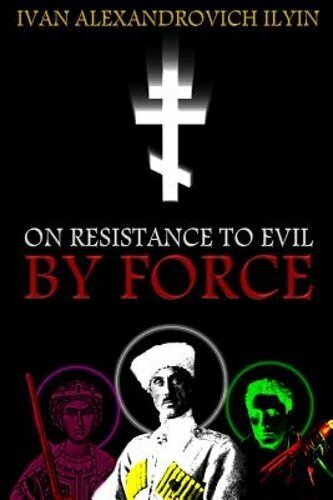
On Resistance to Evil by Force
Chapter 13: Overall Framework
June 03, 2026
post photo preview

Sorry for the delays this month - Allen's passing has really taken a lot more time and energy than I anticipated.  Thank you for sticking with me.

Ilyin opens the chapter by pointing out that only the truly good and truly faithful get to have a say in this discussion.  The spiritually lukewarm "come as you are" Christians or the "Living My Truth" folks are not morally strong enough to have a say.  They always equivocate or rationalize rather than take a stand.

An interesting point that Ilyin makes in this chapter is that no one ever asks if the villain is justified or morally right in his actions, only the righteous defender or person who intervenes.  They know that the villain isn't but did it anyway.  It's far easier to make the virtuous person feel guilty than the villain.  We saw this in our current world with both the Rittenhouse and Penny cases.  No one disucssed the attackers, just the defenders.  Saint Floyd is yet another example of this.

According to the text, our purpose in intervention should flow from a will to do good and to turn others to good.  We must aim to strengthen & implement good in the soul.

The weak and fearful always equalize good and evil in order to justify their own inaction.  They claim that everyone has a reason for the things they do and that culture/class differences cause evil behavior (sound familiar?).  The truth is that evil and good ARE NOT equal and neither are people who act evil and those who act good.  Never fall into this trap.

Interestingly, Ilyin said that people in his time said that you can't fix humanity's problems with incarceration and capital punishment.  It is so crazy that 100 years later, we are hearing people say the exact same thing.

Ilyin points out that physical action by itself is not enough.  We need faithfully directed social education towards good.  Force itself is temporary, spiritual foundations are permanent.

He explains it in a good way next.  Good and evil are in the mind, but they work through our physical bodies via physical action.  In order to stop physical evil, we must sometimes use our bodies (physical force) to stop the evil actions of another body (physical resistance by force).

While force is sometimes needed and perfectly permissible, it's use should be limited and a last resort.  Mental/spiritual complusion and reason should be used first, whenever possible, as it provides more lasting change than physical restraint does.  For this same reason, we must object to things like excessive force and torture.  While they might get compliance, it isn't spiritual compliance.  These things also breed contempt.

Ilyin notes that you cannot use force to compel love.

According to Ilyin, the use of force should not deprive the other person for the chance to use free will to change their behavior.  As long as reasoning works, it should be used and force avoided.  Phyiscal force, according to Ilyin, is permissible only when psychospiritual action (reasoning/appeals to humanity) is insufficient, invalid, or unfeasible.  Other factors to consider when deciding to use force include the time available (is an attack in progress or imminent), the intelligence or maturity level of the subject, the morality or culture of the subject, crowd behavior, and war considerations (not much reasoning during battle).

Ilyin makes another great point: We must always strive to comprehend the nature of evil and always be finding ways and means to overcome it.

Ilyin closes this chapter with 5 rules for the use of physical force in resistance to evil:

  1. We must be vigilant to recognize evil and to distinguish it from things that look similar (stupidity can look a lot like evil).
  2. We must learn how to prevent the growth of evil and to cultivate good.
  3. The one who resists must begin with spiritual measures whenever possible and understand that force is not independent of spiritual means.  They must be used together.
  4. We must understand when to stop using force and compulsion.
  5. We must keep tabs on our own motives to prevent evil from growing in us as we fight evil.

I loved this chapter.  Let me know your thoughts below.

community logo
Join the Tactical Wisdom Community
To read more articles like this, sign up and join my community today
1
What else you may like…
Videos
Posts
Articles
BattlBox Mission 134 Unboxing

Here's my unboxing of BattlBox Mission 134: Every Day Carry. I highly recommned BattlBox.

Link to BattlBox: https://classic.avantlink.com/click.php?tool_type=ml&merchant_link_id=18d5f0dc-a5d5-4617-8d89-3672fa873181&website_id=b54d42a2-3e73-4f03-ac0d-a3e7b99eed53

00:14:14
Hoplite M10 Review

My video review of the Hoplite M10 Reusable Flashbang. It's a great tool available at: https://www.hoplitegear.com/product-page/m10-havoc

00:06:46
Timeline Cleanse

Time for a timeline Cleanse before WW3 kicks off.

00:00:10
INTEL BRIEF - SAUDI ARABIA

The Houthis have struck the port of Yanbu again. Last time they hit the Aramco facility, this time they hit the port itself.

INTEL BRIEF - RED SEA

An Ambrey Maritime On Board Security Team repelled a pirate boarding attempt off the coast of Yemen last night. A small boat with at least 7 pirates aboard pulled alongside and began a boarding attempt when the security team fired warning shots. The pirates remembered that they had urgent business elsewhere once they realized the ship had armed personnel aboard.

INTEL BRIEF - NETHERLANDS

20 different locations along rail lines had large pipes placed on them to make the system believe the tracks were blocked, causing major disruptions.

post photo preview
On Resistance to Evil by Force Study
Chapter 17 - On the Relationship of People in Good & Evil

Ilyin first describes our moral obligation to first attempt through conversation to change someone's evil will.  After that, we can then morally resist their evil deeds.  Our requirement to live together in harmony requires to try and stop evil deeds while they are still just thoughts, to permanently change someone's will.

He points out that we are the worst judges of ourselves.  We all keep and inner and outer self; one reserved for ourselves and one that is public-facing.  We all self-delude ourselves into believing that we are always the good guy and that we have no faults.  We get mad when we are "unfairly blamed", when actually being called out for our bad behavior.

Ilyin describes nonverbal communication well.  Every act or attitude we take is physically manifested within us and becomes part of our outward appearance, whether for good or bad, if peolpe just take time to notice.  He calls it "unconscious integrity of communication and transmission".  

According to Ilyin, you cannot be "evil inside" or "good inside", and not have it affecrt teh outside world.  If you have evil inside, you spread evil around you.  If you are good inside, you spread good to all those you touch. "A good man is a living hearth of good & strength in good, while an evil man is a living hearth of evil, strength in evil and weakness in good."  

We have a duty to resist evil interally within us.

Ilyin says that we are OBLIGATED to resist evil everywhere for the good of all.  He says we are obliged to fight evil at every turn and that we have no right at all to allow evil to go unchecked.  We MUST act against and not let it mutliply.  He claims this is a spiritual call and a public duty. 

He says there is no right to commit evil.  Those who are naive enough to believe that others have a freedom to commit evil will eventually become slaves to it.

After describing this, he points out again that we all have a public duty for the good of all to actively resist evil anywhere.  We obligated to resist evildoers and villains as well as to resist proactively and effectively. 

"Anyone who sends evil must always be cognizant of this and accept that others will be permitted to put a stop to his wicked acts and force him to qualitatively review the evil he sends"

That quote was the basis for law and safety in the old west - before I attack someone, I have to decide if I'm willing to get shot for it.  We need to RETVRN.

Ilyin says that as a society, we all have a desire to see good grow.  Evil people threaten that and threaten our peace, so we must unite against villains in our midst.  Those villains must be met by united resistance and opposition.  Ilyin points out that the resistance to evil is done by few on beahlf of all and benefits a community as a whole.

In the book, Ilyin points out that for any central authority, whether state or church, to exist, it must be supported by the people for the good of the whole, with submitting to it for the good of all.  He believed that the reason that Russia turned communist was because the people desired to submit to the state for the good of themsleves (taking from the rich and giving it to the individual).  The US Constitution as originally written met Ilyin's requirements.  Notably, the church's "Military Orders" or knights, also did.  When governments failed to protect citizens, the church did, and the citizens willingly submitted to the local order.

He points out something here that illustrates our current issues.  He said that as soon as a government begins to appease the villains or the people harbor them, society falls.  That's exactly where we are today.

Let me know your thoughts below.



Read full Article
post photo preview
On Resistance to Evil by Force Study
Chapter 16 - On the Modification of Love

Ilyin starts out by defining what most people consider to be love "What is nice is good", or that which we are sympathetic to.  He points out that perfection is actually what is good and worthy of love.  He posits that people like things that give them pleasure and confuse that for love, but it is shallow and unmeaningful.

On the contrary, spiritual love means that we do what is right, even if it is not pleasant, not fun, and not nice, even if it leads to discomfort, unpleasantness, or difficulty.  For spiritual love, even suffering is worth it.

According to Ilyin, Christ's two basic Commandments were to love God and to love your neighbor.  He points out that when your neighbor (fellow man) is doing evil, resisting him would seem to be in contradiction to "loving" him, but not resisting violates the love of God.  The love of God (doing what is right in His eyes) outweighs any sympathy or "love" for your neighbor.  If someone has removed God from their lives, they need us to tell them "no", rather than modern society telling them "yes", and thus resistance to evil.

The proponents of "love wins" and "love trumps all", claim that condemning people for their choices and evil deeds is labeled as "hate", "intolerance", and "malice", and thus encourage no limits on behavior.  If I truly love my neighbor, I MUST be able to tell him no, that his behavior is unacceptable, and that I will resist their actions.  Refusing to put them on the right path out of "love" is not truly love and is actually helping to condemn their soul.  Ilyin interestingly paraphrases the idea that "acceptance is not a Christian Virtue".

Ilyin reminds us that while we should indeed love our neighbor, we CANNOT EVER love evil in a man.  There are some people who are just evil.  No amount of acceptance or sympathy will ever change them, and we must modify our approach to resistance.

The only thing we can truly love completely without conditions is God.

When true good is confronted by true evil, evil must be destroyed and, as Ilyin says, executed.  When we resist using force, we do not become evil, as, in the end, we pray for the salvation of the soul of the executed person.

Ilyin points out that we begin with disapproval and work our way through a series of escalating responses to evil done in our presence, which can (and should) include ruthlessness against evildoers.  Remember God's commands to Joshua about what to do to anyone who resisted him.  Ilyin posits that true love of good requires it.

He uses the example of Jesus driving the money changers from the Temple as the justification for righteous application of force in the presence of and resistance to evil.

Ilyin says that resistance to evil can be summed up like this: "the struggle is fought with love, but with spiritualized love."

We must resist evil out of a love for good, not for vengeance, revenge, greed, or desire for power.

The struggle against evil is done from love.

Here's the closing quote, which I love: "but the active resistance against the villain's evil designs on others, and against the villain himself is not evil, but good."

Let me know your thoughts below.

Read full Article
post photo preview
On Resistance to Evil By Force Study
Chapter 15: On the Limits of Love

Man, this chapter is FULL of good stuff, despite it being relatively short.

Spiritual Love and devotion is a CHOICE.  It's not born into us, we have to decide to choose good over evil and prefer it.  According to Ilyin, you cannot love everything (as the left says) or love all things equally.  Those who say they do are either incorrect or are so self-centered that they don't actually love anything but themselves.

According to the text, we love everyone to the extent that they do good.  Love of evil, evil people, or the devil is UNNATURAL.

Ilyin writes that we must NEVER accept evil.  Accepting evil, or identifying with it, leads to temptation and eventual submission.

According to our homeboy Ilyin, the only position Christians can take when faced with evil is with a drawn sword.

Next, Ilyin DESTROYS one of the biggest fallacies that the modern church pushes on us: "Love your enemies" refers only to your own personal haters & persecutors, NOT the enemies of God.  BOOM.  Christ never called us to love the enemies of God.  Christ Himself actually had fiery words and threats of retribution for evildoers.  Therefore, loving, forgiving, and caring for the enemies of God is against God's will.

When the Bible says to "forgive", it says to forgive those who sin AGAINST YOU, not God.  The Bible refers to forgiving "brothers" or fellow followers of The Way, not everyone.  In fact, it even points out that if a brother refuses to change, you can treat him as a heathen.  According to Ivan, those who can "forgive all" have a personal worldview, rather than a spiritual one.

According to Ilyin, forgiveness doesn't stop evil, it just stops the emotional impact it has on you.  The villain is still free to impact others.  Forgiveness doesn't mean we shouldn't intervene.

Indifference towards evil done to others shows a lack of will and spirit.

There is a great quote here: "Permissiveness has nothing to do with Christian forgiveness."

When we resist, we must not do so to punish, but to restrain behavior.  

To the villain, forgiveness is encouragement to continue.

Ilyin asks: Do we have to let the victim be harmed by the villain to show our gentleness and restraint?  He points out that this is a betayal.

Straight FIRE chapter.  Discuss below.

Read full Article
See More
Available on mobile and TV devices
google store google store app store app store
google store google store app tv store app tv store amazon store amazon store roku store roku store
Powered by Locals