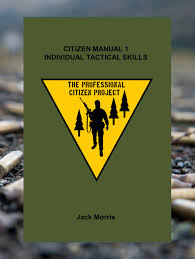
On the recommendation of Alpha Charlie Concepts, I bought a few of the "Professional Citizen Project" Manuals and we're going to review them.
Today, we are reviewing "Citizen Manual 1: Individual Tactical Skills".
Link: Citizen Manual 1
The book covers, as the name implies, basic indivual tactical skills. It talks about how to shoot, move, and communicate in a potentially hostile environment. To his credit, the author starts with warning that you can't learn these skills simply from reading, you need to get out and take actual classes with real-world instructors. This book covers the skills you would learn by taking my fieldcraft class and NC Scout's Scout course. Get out and train.
The opening chapters are devoted to gear and gear set up, as they should be. He gives some input on selecting optics, but most of the information is on choosing and setting up a belt kit, load bearing vest, or chest rig. This is pretty helpful, because a lot of the questions we get in class and a lot of the down time in class is spent on adjusting and setting up student's gear.
Some of the military leadership stuff in the beginning doesn't really apply to our role as armed citizens, in my humble opinion. Sure, the military decision making process and leadership process is good to know, but to most it's not really applicable. I don't need to understand commanders intent two levels higher, as there is not really that kind of leadership established. It doesn't make the book bad at all, it's just filler that most won't understand anyways.
The "Shoot" chapter is outstanding. He talks about standardizing your groups guns and how to set up a rifle for fighting. He gives a pretty good discussion on the need to zero and how to zero a rifle and optic. My main disagreement here is on his recommendation of QD attachments for slings. As most of you know, both Matt and I disagree with this because QD attachments have a habit of coming undone on their own, and, as I've seen a handful of times, can cause a negligent discharge (you know who you are).
The section on land navigation is good, but very basic. You need face to face instruction and following a course to actually get good at land navigation (Personally, I'd take Fieldcraft from that TW dude).He gives a great descritopn of dead reckoning and planning a route, so it's good.
The one issue I have in the movement section is his explanation of the purpose of the SLLS (Stop/Look/Listen/Smell). He says that it is done right after leaving friendly lines to get accustomed to the sights, sounds, and smells of the battlefield. Maybe is a Marine versus Army thing (although Matt teaches it the same as I do) but I learned that the purpose of the SLLS is to occasionally stop, look, listen, and smell for signs of the enemy and it should be done way more often than just when leaving friendly lines. By the way, as armed citizens, there aren't really "friendly lines".
He gives a good discussion on the discipline aspects of military movement, like camouflage, light, and sound discipline. Moving in formations is covered very well. The only issue here was some use of jargon like REDCON1, WARNO, and OPORD. Listen, as similar as it is to military actions, civilian preparedness is not the same. If I was moving with a group of legit combat vets, I could just say "REDCON1" and know that everyone is going to lock on, but with a group of folks who are just learning this stuff and maybe just read a book, wouldn't it just be easier to say "GET READY"? Jargon does make us sound cool, but in all honesty, we aren't going to be issuing WARNO's or FRAGO's in military format, we're just going to tell folks what the new plan is. Sure, it's the same thing, but why confuse it with forcing folks to learn new jargon? We are NOT light infantry, even if we are using light infantry skills and tactics.
He only covers three individual movement techniques, but he does cover them well. He covers the high crawl, low crawl, and the 3-5 second rush. The techniques and his description are solid. However, none of them are actually useful for patrolling. They're great for combat, but knowing things like the creep, kitten walk, or fox step (in TW-2) will help you during patrolling, along with the monkey walk (also in TW2).
The actions on contact drills are solid and well explained. He covers the same reactions and battle drills that Matt and I do in our classes. Unlike a lot of other manuals, he covers reaction to unmanned aerial systems (drones), which is fantastic. Learn to react to drones overhead (hint: get under overhead cover).
The communications section is very good. He covers hand and arm signals, radio, and report formats. He uses all the same formats we do and the COMSEC procedures he covers are the same ones we teach. The only issue I had here was on disucssing a "slant" report, which is a purely military adminstratvie report (combat power report) that we don't need to waste time on in a civilian context. We don't have a battalion to track on a wall map.
He begins the survive section with first aid, and he again highly recommends taking a first aid class. My personal recommendation is that EVERY PERSON on your team needs to have a 2-day wilderness first aid course, a Stop The Bleed course, and a CPR course. He goes into MARCH and the treament of a good number of injuries. He covered tactical combat causualty care very well, but, like most books in our circle, combat injuries are focused on too much. Sure, I should be able to treat a gunshot wound but I bet you I'll need to treat a sprained ankle more often. Also, when discussing respiration, the main topic covered was tension pneumothorax and the need to carry a 3.25" long 14 gauge needle. Listen, that's a specialized skill, and you can hurt someone with it. Yep, it's a good thing to know, but it's not the only cause of respiratory issues (it comes from a combat injury only focus).
There is a good discussion on water, water purification, and food selection. Very well done, but he does say that when picking out food for your pack, you need to consider SLLS and I'm not exactly sure why, but I'm sure there is a good reason.
The shelter discussion discusses clothing and keeping your clothes operable. He describes shelters and how to set up a lean to and an A frame which are good discussions. The BLISS acronym is also covered.
All in all, it is a very good basic training reference for your group. Not a bad book to have in your library, if you have minimal training. It's a good refersher for experienced people as well.
Next time, we'll cover CM-2 Reconnaissance.