


Tactical Wisdom
Politics • News • Preparedness
A community of preparedness people, with a biblical foundation. We discuss preparedness advice, my books, and current events.
Interested? Want to learn more about the community?
What else you may like…
Videos
Posts
Articles
Hoplite M10 Review

My video review of the Hoplite M10 Reusable Flashbang. It's a great tool available at: https://www.hoplitegear.com/product-page/m10-havoc

00:06:46
Timeline Cleanse

Time for a timeline Cleanse before WW3 kicks off.

00:00:10
INTEL UPDATE - GUYANA

This appears to be video from the fighting on the Venezuela-Guyana border.

00:00:36
INTEL BRIEF - CANADA

There was a school shooting in Canada today. The shooter appears to have been a trans person identified as Jesse Strang.

INTEL UPDATE - IRAN

Iran has launched another drone towards the Lincoln Task Force.

WAR WARNING - IRAN

According to Reuters, an Iranian Shahed 139 drone was just shot down by an F35 as it approached the USS Abraham Lincoln.

Editors note: How close was this ship to the Gulf of Tonkin? (I know.....its a joke)

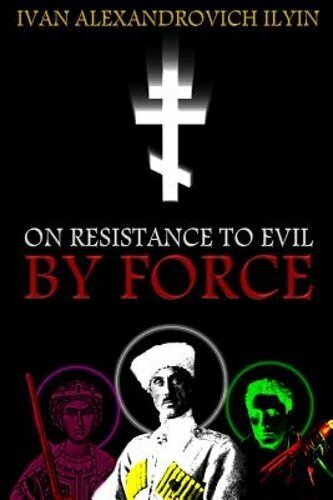
On Resistance to Evil by Force Study
Chapters 5 & 6

As we continue through the book, we are now on Chapters 5 & 6.  

Chapter 5: On Mental Compulsion

Mental compulsion, as we learned last time, can be either internal (from our own spirit) or external (arguments and warnings from others).  Inducement, on it's own, is not inherently evil.  We can can compel or induce ourselves to do either good or evil.  

I found it interesting that Ilyin pointed out that forcing a smile or agreement when you don't really feel it is inherently evil, because you are compelling yourself against your own better nature.  Left unchecked, you will find yourself accepting more and lying more.  It represents a spiritual betrayal of your own body's principles.

On a daily basis, Ilyin notes, we have to induce ourselves against things like laziness and spiritual weakness, and this inducement is good.

A great point he makes is that believing in unconditional free will, or "I can do whatever I want without consequences", is naive and silly.  He also states clearly that believing that nonviolence wins people over or will change their behavior is also naive.

As man is a socially dependent and socially adaptable being, Ilyin says that we need to educate and induce the spinless and weak.  When we don't disapprove or object to their moral weakness, it encourages more indulgence, acceptance, and eventual complicity.  In other words, if we don't object to evil, the idea that "everything is permitted" wins.

In another stunning parallel with the modern world, Ilyin pointed out that children develop from the teaching and influence of others, whether that be their parents, teachers, or church.  Children are easy to induce into patterns of thinking.  In the modern context, parents are so involved in their own lives that teachers and day care providers have an out-grown influence and that is why we are where we are today.

He also says that social condemnation of behaviors and ideas plays a role (taking a page from Blaine Pardoe and social enforcement).  My best example here is that sexual deviance (homosexualtity/trans/etc) used to be socially condemned and now it isn't.  Would you say our society is better or worse with the removal of social condemnation?  Also, most of the performative protesting we see know is "social condemnation", for example, protestors harassing a business for refusing to issue a statement against ICE or Trump.  I'd say Ilyin was spot on.

Following this, he points out that social compulsion or condemnation should only be used to STRENGTHEN our own spiritual self-inducement.  Laws should not be written to punish, but to encourage voluntary compliance in line with our own societal/cultural values (in other words, "hate speech" laws are evil).

He ends the chapter with the idea that if we have laws that we don't enforce or enforce selectively because they don't reflect our values, they become meaningless words on paper.

Chapter 6: On Physical Compulsion and Suppression

Ilyin opens with the idea that if self mental inducement and external mental compulsion don't work, only physical complulsion can.  He gives a great example in the chapter of a child taking a boat out into the open sea.  The child didn't self-induce themselves not to, and if you warned them not to, would you just let them get on the boat and go out to sea?  No, you would physically stop the child.

Another great example is a friend who is so angry that they are about to commit an assault or worse.  Their self-inducement failed due to anger, they wouldn't listen to you, so then you are forced to physically restrain them until they come to their senses again.  These two uses of physical force are inherently good, but Tolstoy's definition would render them evil.  Also, we know that using physical force to prevent a crime or potential physical harm (stopping someone from stepping in front of a bus) is OK, so therefore it is not inherently evil.

On it's own, once again, physical compulsion cannot be either good or evil, it is neutral.  The state of our soul during the physical measures is what determines whether it is an evil act or a good one.  Hence, the intentional use of violence or force on another is not inherently evil, nor is it inherently good.  It's PURPOSE is what can be evil or good.

If the intent of physical compulsion or suppression is to increase someone's own internal compulsion (ie, restraint to make them "stop and think") and correction, then it is good.

If the use of physical compulsion seeks to weaken or destroy it (torture, etc), then it is evil.

Another interesting parallel Ilyin draws to the current day, for me, was when he pointed out that compelling or inducing others to hate other people or groups of people is inherently evil.  This is the left calling for everyone to hate white people or ICE or Trump or MAGA, take your pick.

Iylin points out that violence is unpleasant and causes suffering on both sides, but that doesn't make it evil.  Likewise, everything that brings us pleasure or is pleasant isn't inherently good (drugs/sexual deviance).  It is, once again, the intent that does so.

An argument he makes that I like is that people often get mad when we do good, so should we stop doing good?  Of course not.

The final point in this chapter that I liked was that an insistance on shared standards is not evil.  A refusal to do so is.

Please share your ideas and thoughts on these chapters in the comments.

Read full Article
On Resistance to Evil By Force Study
Chapters 3 & 4

This week, we are diving into Chapter 3, On Good & Evil and Chapter 4 On Iducement & Violence.

Chapter 3: On Good & Evil

Ilyin begins with explaining that worldly events are not evil in and of themselves, they just are.  Most of the time, when people ask why God allows evil to happen, it's not actually evil, it's just nature.  He points out that these events then bring out the evil in people.

This brings me to a point of my own - bad things happen here because the earth is ruled by Satan.  When you remember that, things become much more clear.

Ilyin also mentions evil begins in PEOPLE, not some random natural power.  He also points out that individual actions aren't evil, the motivations behind them are.  For example, if I push you in the street to keep you from getting hit by a car, the push itself isn't automatically evil.  Now, if I pushed you IN FRONT OF a car, that would indeed be evil, because of my motivation - the push itself still isn't evil, it is neutral.  If I take the wallet from an unconscious person to find out who they are and reach a next of kin, that's very different from the same act with the intent to steal the wallet.  The act isn't evil, the human intent behind it is.  In a potential without rule of law situation, my policy of removing operable arms from dead folks isn't evil, because the intent is to prevent bad folks from picking them up and harming others.  On the other hand, if I picked them up to then attack someone else in their home and steal their things, that is indeed evil.  Again, the act itself from a purely physical standpoint is neutral, the motivation for doing so is the key.

We have to be careful in assigning motive because a lot of evil people smile at you and say "good morning", but their heart isn't in it and the greeting is just a ritual.  Analyze the whole of a person, not a specific behavior or two.

Ilyin says that unmanifested evil lives inside of us all and we must guard against it coming out.  For example, we've all had thoughts of punching someone in the face...but whether we act on it or not is the true good or evil part.  Guard against giving to evil impulses, like harm for the sake of harm.

According to Ilyin, the difference can be described like this: Good is spiritualized love and evil is anti-spiritual hatred.  The hate itself, though, is not evil, Ilyin stresses.  Many churches will tell you that hate is wrong, but God Himself hates evil and evildoers - therefore, hate in and of itself in NOT objectively evil.  We must all hate evil.  To prove this, Ilyin quotes from the book of Matthew: "The greatest Commandment is to love the Father."

Once we get to a place of spiritualized love, we can then fight evil in ourselves and in others, out of love.  Resisting evil, Ilyin says, flows out of love, from love, and through love.

The biggest teaching from this chapter is that we MUST NOT accept the premise that we must not resist evil by force as evil will very willingly use force on us, and us dying or being harmed serves no purpose.  God requires you to have a purpose.  Failing to resist evil by force would require us all to let evil flourish unhindered and unimpeded.

I don't know about you, but I'm not built that way.

Chapter 4: On Inducement and Violence

This chapter gets very clunky in it's discussion terminology and the changing of definitions, but it's also vital for exactly that reason - changing definitions is a way to induce people to do or not do things, but we'll talk about that in a bit.

Inducement is convincing someone to do or not do something.  It's isn't always evil.  We can convince people to do good or others can convince people to do bad.  In the end, inducement results in the other person deciding to do or not do something, so it can't be considered force, even though we say things like "the force of my argument."

Compulsion is like force, but is really just a stronger argument.  For example, we are all compelled to do or not do things via the system of laws that allow us to live in a society.  However, in the end, we still voluntarily consent to such compulsion, so it's still a choice.  Many in a society chose to not obey.  When they don't obey and break the law, the state uses force to compel them.  I can also use physical force to compel you to do or not do things, such as stopping you from crossing the street into traffic or by pulling you out of the way of a moving car.  Again ,the act of using phyical compulsion is neutral, my motive is what decides if the physical act is good or evil.

The word violence causes an emotional reaction in all of us. The word violence generally means an unprovoked and unjustified attack upon an innocent party.  That's the immediate mental image we get when with think of the word "violence".  It's a loaded term, meant to bring about an emotional reaction.  As Ilyin points out, "we all accept that violence, as random force on a victim, is wrong".

Ilyin notes that that is exactly why Tolstoy and his friends applied the term violence to things that are not violence.  Modern leftists do the same thing.  They say "silence is violence" or "not validating my feelings is violence".  They do this to manipulate people because we all know violence for the sake of violence is evil.  Again, I find it odd that Ilyin was able to pinpoint our current moment so accurately 100 years ago, but then again, our enemies are using the same playbook as his 100 years ago.

Here's the best point of these two chapters: Tolstoy's position of never using "violence", or physical resistance by force, because it is inherently evil would require us all to allow others to freely use violence on us.  That is suicidal and not in God's will at all.

By the end of the week, we'll get into the next couple of chapters.

Discuss your thoughts below.


Read full Article
post photo preview
On Resistance to Evil by Force Study
Chapters 1 &2

On Resistance to Evil by Force is one of my favorites.  Ivan Ilyin was a Russian who was imprisoned and then exiled during the Russian Revolution.  He wrote this book in 1925, during the Revolution, as a response to the writings of fellow Russian Leo Tolstoy, who was exorting Russian Christian men to be pacifists in the face of the Communist revolt.  Tolstoy was more of an anarchist than a Communist, but he felt that Christ led everyone to always be pacifist because the use of force always led to one party subjugating the other.  I find that this argument is exactly what's wrong with the modern church as we struggle with our own Communist revolution.  Ilyin wrote this book to present the case that Christians must resist evil, even by force.

Every few days, I'll post my thoughts on a couple of chapters.  You all can put your thoughts in the comments and hopefully we'll all learn a few things from each other's ideas.  I'll leave the first chapter open to non-members to try and encourage others to become supporters.

It's just as important to train and instruct our minds and moral framework as it is to train our physical bodies on new skills and gear.

Chapter 1 - Introduction

In this chapter, he is basically explaining why he's writing the book.  I get the general impression early on that he really doesn't like Tolstoy, but by the end of Chapter 2, I realized that he had immense respect for Tolstoy's faith, but he despised Tolstoy's ridiculous interpretation of Scripture.  I concur.

Right off the bat, Ilyin lays out this great line: "Ignorance leads him to trials and torments, and through agony the soul is purified and sees, through a clear-sighted gaze, the source of wisdom is given in the form of clarity."  This rings true for all of us.  We make a mistake, we deal with the fallout of the mistake, and then we see what the clear path was.  Hey, wisdom isn't cheap.

As we face a Communist Revolution here, his commentary on the Russian Revolution seems especially relevant: "It is the first time a genuine evil has been given to the human spirit with such frankness."  Yep - Communism is the enablement of greed, theft, and abuse on our fellow man.  Pure evil.

One of the best gems in the introduction is the idea that we shouldn't allow anyone else's condemnation of our faith penetrate to our hearts.  He pointed out that the Bolsheiveks used Christianity as a club to beat people into submission, much like we are seeing now.  His point was to not let them change your mind under any circumstances.  They call it backwards?  Ignore them - they're ones who are wrong.

Another point he illustrated that has parallels in the modern day is that heroes were treated as villains and the weak or timid are treated as virtuous.  The idea is to break down rugged individualism in favor of collectivism (I'm looking at you, Mamdani).  At the time, they vilified anyone who stood up against the Communists and treated as heroes those who gave up and stepped out of the way.  That leads nowhere good, and it's what we're seeing in our society.

The final great point in the introduction: "....imparting a counterfeit facade to the spirit of Christ's teaching poisoned Russian religious and political culture."  False teachers are out there today doing this same thing.  Lesbian pastors, "All are welcome here", and "Jesus is my boyfriend" churches are all preaching pacifist and liberation theology that have absolutely no basis in the Bible.  No, Jesus was not a Socialist ("even when we were with you, we had this one rule, he who does not work does not eat").  Helping the poor and welcoming the traveler does NOT mean give handouts or let people trample your homeland demanding things.


Only for Supporters
To read the rest of this article and access other paid content, you must be a supporter
Read full Article
See More
Available on mobile and TV devices
google store google store app store app store
google store google store app tv store app tv store amazon store amazon store roku store roku store
Powered by Locals