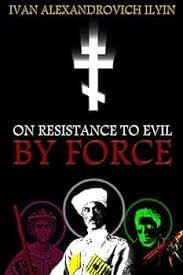
As we continue through the book, we are now on Chapters 5 & 6.
Chapter 5: On Mental Compulsion
Mental compulsion, as we learned last time, can be either internal (from our own spirit) or external (arguments and warnings from others). Inducement, on it's own, is not inherently evil. We can can compel or induce ourselves to do either good or evil.
I found it interesting that Ilyin pointed out that forcing a smile or agreement when you don't really feel it is inherently evil, because you are compelling yourself against your own better nature. Left unchecked, you will find yourself accepting more and lying more. It represents a spiritual betrayal of your own body's principles.
On a daily basis, Ilyin notes, we have to induce ourselves against things like laziness and spiritual weakness, and this inducement is good.
A great point he makes is that believing in unconditional free will, or "I can do whatever I want without consequences", is naive and silly. He also states clearly that believing that nonviolence wins people over or will change their behavior is also naive.
As man is a socially dependent and socially adaptable being, Ilyin says that we need to educate and induce the spinless and weak. When we don't disapprove or object to their moral weakness, it encourages more indulgence, acceptance, and eventual complicity. In other words, if we don't object to evil, the idea that "everything is permitted" wins.
In another stunning parallel with the modern world, Ilyin pointed out that children develop from the teaching and influence of others, whether that be their parents, teachers, or church. Children are easy to induce into patterns of thinking. In the modern context, parents are so involved in their own lives that teachers and day care providers have an out-grown influence and that is why we are where we are today.
He also says that social condemnation of behaviors and ideas plays a role (taking a page from Blaine Pardoe and social enforcement). My best example here is that sexual deviance (homosexualtity/trans/etc) used to be socially condemned and now it isn't. Would you say our society is better or worse with the removal of social condemnation? Also, most of the performative protesting we see know is "social condemnation", for example, protestors harassing a business for refusing to issue a statement against ICE or Trump. I'd say Ilyin was spot on.
Following this, he points out that social compulsion or condemnation should only be used to STRENGTHEN our own spiritual self-inducement. Laws should not be written to punish, but to encourage voluntary compliance in line with our own societal/cultural values (in other words, "hate speech" laws are evil).
He ends the chapter with the idea that if we have laws that we don't enforce or enforce selectively because they don't reflect our values, they become meaningless words on paper.
Chapter 6: On Physical Compulsion and Suppression
Ilyin opens with the idea that if self mental inducement and external mental compulsion don't work, only physical complulsion can. He gives a great example in the chapter of a child taking a boat out into the open sea. The child didn't self-induce themselves not to, and if you warned them not to, would you just let them get on the boat and go out to sea? No, you would physically stop the child.
Another great example is a friend who is so angry that they are about to commit an assault or worse. Their self-inducement failed due to anger, they wouldn't listen to you, so then you are forced to physically restrain them until they come to their senses again. These two uses of physical force are inherently good, but Tolstoy's definition would render them evil. Also, we know that using physical force to prevent a crime or potential physical harm (stopping someone from stepping in front of a bus) is OK, so therefore it is not inherently evil.
On it's own, once again, physical compulsion cannot be either good or evil, it is neutral. The state of our soul during the physical measures is what determines whether it is an evil act or a good one. Hence, the intentional use of violence or force on another is not inherently evil, nor is it inherently good. It's PURPOSE is what can be evil or good.
If the intent of physical compulsion or suppression is to increase someone's own internal compulsion (ie, restraint to make them "stop and think") and correction, then it is good.
If the use of physical compulsion seeks to weaken or destroy it (torture, etc), then it is evil.
Another interesting parallel Ilyin draws to the current day, for me, was when he pointed out that compelling or inducing others to hate other people or groups of people is inherently evil. This is the left calling for everyone to hate white people or ICE or Trump or MAGA, take your pick.
Iylin points out that violence is unpleasant and causes suffering on both sides, but that doesn't make it evil. Likewise, everything that brings us pleasure or is pleasant isn't inherently good (drugs/sexual deviance). It is, once again, the intent that does so.
An argument he makes that I like is that people often get mad when we do good, so should we stop doing good? Of course not.
The final point in this chapter that I liked was that an insistance on shared standards is not evil. A refusal to do so is.
Please share your ideas and thoughts on these chapters in the comments.