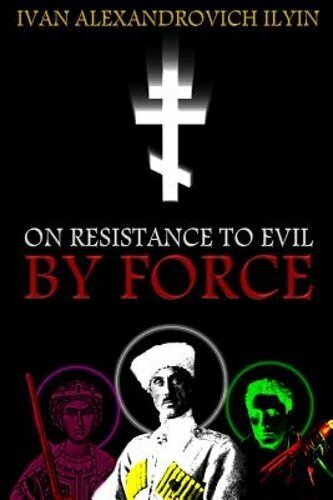
This week, we are diving into Chapter 3, On Good & Evil and Chapter 4 On Iducement & Violence.
Chapter 3: On Good & Evil
Ilyin begins with explaining that worldly events are not evil in and of themselves, they just are. Most of the time, when people ask why God allows evil to happen, it's not actually evil, it's just nature. He points out that these events then bring out the evil in people.
This brings me to a point of my own - bad things happen here because the earth is ruled by Satan. When you remember that, things become much more clear.
Ilyin also mentions evil begins in PEOPLE, not some random natural power. He also points out that individual actions aren't evil, the motivations behind them are. For example, if I push you in the street to keep you from getting hit by a car, the push itself isn't automatically evil. Now, if I pushed you IN FRONT OF a car, that would indeed be evil, because of my motivation - the push itself still isn't evil, it is neutral. If I take the wallet from an unconscious person to find out who they are and reach a next of kin, that's very different from the same act with the intent to steal the wallet. The act isn't evil, the human intent behind it is. In a potential without rule of law situation, my policy of removing operable arms from dead folks isn't evil, because the intent is to prevent bad folks from picking them up and harming others. On the other hand, if I picked them up to then attack someone else in their home and steal their things, that is indeed evil. Again, the act itself from a purely physical standpoint is neutral, the motivation for doing so is the key.
We have to be careful in assigning motive because a lot of evil people smile at you and say "good morning", but their heart isn't in it and the greeting is just a ritual. Analyze the whole of a person, not a specific behavior or two.
Ilyin says that unmanifested evil lives inside of us all and we must guard against it coming out. For example, we've all had thoughts of punching someone in the face...but whether we act on it or not is the true good or evil part. Guard against giving to evil impulses, like harm for the sake of harm.
According to Ilyin, the difference can be described like this: Good is spiritualized love and evil is anti-spiritual hatred. The hate itself, though, is not evil, Ilyin stresses. Many churches will tell you that hate is wrong, but God Himself hates evil and evildoers - therefore, hate in and of itself in NOT objectively evil. We must all hate evil. To prove this, Ilyin quotes from the book of Matthew: "The greatest Commandment is to love the Father."
Once we get to a place of spiritualized love, we can then fight evil in ourselves and in others, out of love. Resisting evil, Ilyin says, flows out of love, from love, and through love.
The biggest teaching from this chapter is that we MUST NOT accept the premise that we must not resist evil by force as evil will very willingly use force on us, and us dying or being harmed serves no purpose. God requires you to have a purpose. Failing to resist evil by force would require us all to let evil flourish unhindered and unimpeded.
I don't know about you, but I'm not built that way.
Chapter 4: On Inducement and Violence
This chapter gets very clunky in it's discussion terminology and the changing of definitions, but it's also vital for exactly that reason - changing definitions is a way to induce people to do or not do things, but we'll talk about that in a bit.
Inducement is convincing someone to do or not do something. It's isn't always evil. We can convince people to do good or others can convince people to do bad. In the end, inducement results in the other person deciding to do or not do something, so it can't be considered force, even though we say things like "the force of my argument."
Compulsion is like force, but is really just a stronger argument. For example, we are all compelled to do or not do things via the system of laws that allow us to live in a society. However, in the end, we still voluntarily consent to such compulsion, so it's still a choice. Many in a society chose to not obey. When they don't obey and break the law, the state uses force to compel them. I can also use physical force to compel you to do or not do things, such as stopping you from crossing the street into traffic or by pulling you out of the way of a moving car. Again ,the act of using phyical compulsion is neutral, my motive is what decides if the physical act is good or evil.
The word violence causes an emotional reaction in all of us. The word violence generally means an unprovoked and unjustified attack upon an innocent party. That's the immediate mental image we get when with think of the word "violence". It's a loaded term, meant to bring about an emotional reaction. As Ilyin points out, "we all accept that violence, as random force on a victim, is wrong".
Ilyin notes that that is exactly why Tolstoy and his friends applied the term violence to things that are not violence. Modern leftists do the same thing. They say "silence is violence" or "not validating my feelings is violence". They do this to manipulate people because we all know violence for the sake of violence is evil. Again, I find it odd that Ilyin was able to pinpoint our current moment so accurately 100 years ago, but then again, our enemies are using the same playbook as his 100 years ago.
Here's the best point of these two chapters: Tolstoy's position of never using "violence", or physical resistance by force, because it is inherently evil would require us all to allow others to freely use violence on us. That is suicidal and not in God's will at all.
By the end of the week, we'll get into the next couple of chapters.
Discuss your thoughts below.